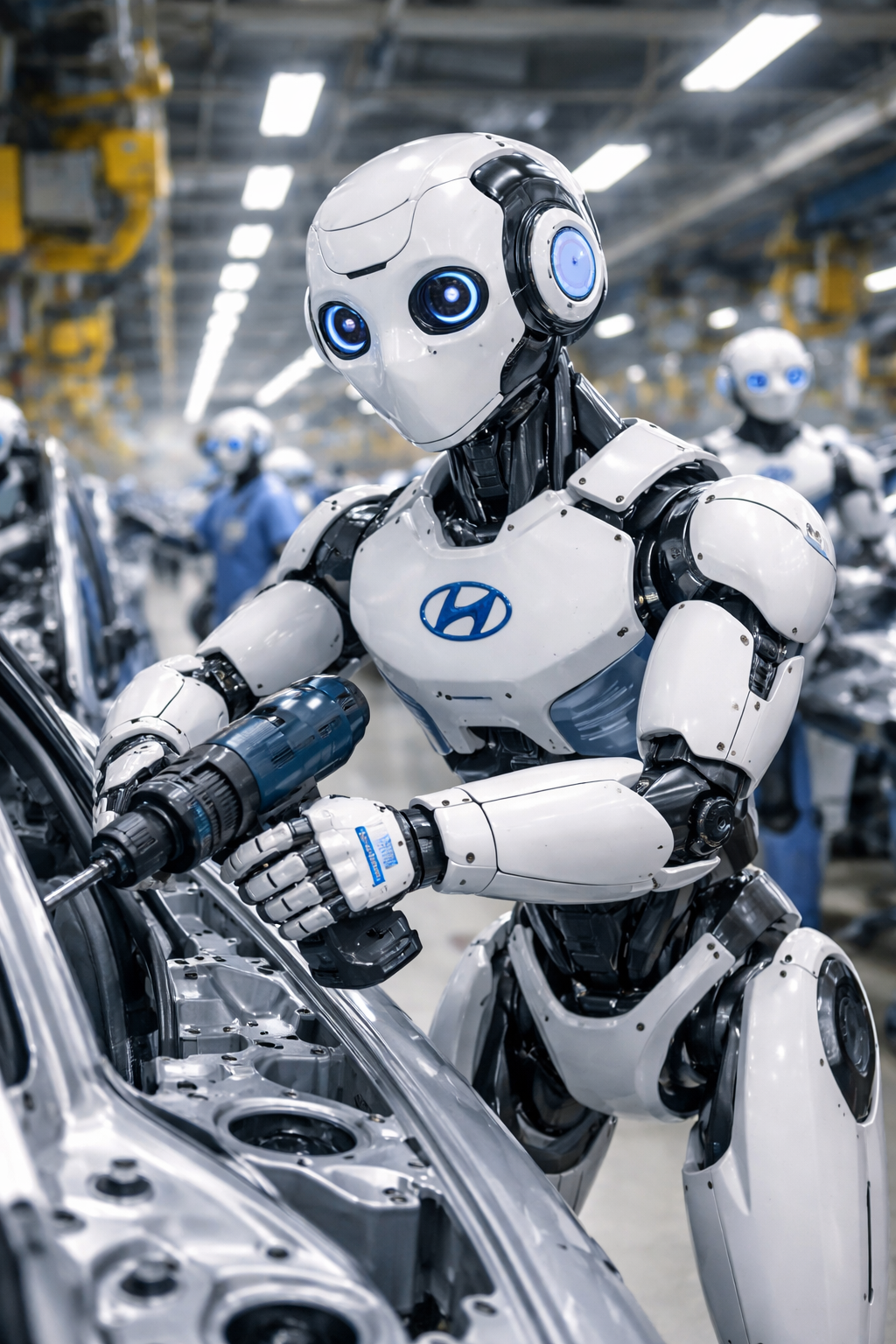
For years, humanoid robots have looked impressive on stage but disappointing in real life. They walked slowly, waved awkwardly, and then disappeared back into research labs. Business leaders watched the demos, nodded politely, and moved on. What mattered was not how human a robot looked, but whether it could actually work. Now, Hyundai is making a clear bet that this gap is finally closing—and that robots are ready to leave the demo stage for the factory floor.
The signal came when Hyundai brought in a former robotics leader from Tesla. This was not a branding move or a flashy announcement meant to grab headlines. It was a practical decision. Hyundai has spent years watching others experiment with humanoid robots while waiting for the moment when the technology could deliver real value. That moment may be arriving.
In the past, many companies wanted robots that could do more than repeat the same motion all day. Traditional industrial robots are powerful, but they are stiff, fenced off, and expensive to reprogram. Humanoid robots promised flexibility, but they lacked balance, awareness, and reliability. The result was a long-standing gap between what robots could show and what they could do. Hyundai’s move suggests that gap is finally small enough to cross.
The hiring matters because it brings lessons learned from Tesla’s real-world struggles. Tesla’s robotics efforts showed how hard it is to move from vision to execution. Building a robot that survives a factory environment is very different from building one that looks good in a controlled lab. Hyundai is signaling that it values experience over hype. It wants leaders who understand broken parts, delayed timelines, and the grind of making hardware work at scale.
Today, the value proposition has changed. Sensors are better. AI systems are more capable. Motors are smaller and stronger. Together, these improvements mean humanoid robots can now handle simple but meaningful tasks like carrying parts, sorting items, or assisting human workers. These are not glamorous jobs, but they are expensive and tiring for people. This is where robots can quietly earn their place.
For manufacturers, this shift hits a present-day pressure point. Labor shortages are real. Training costs are rising. Factories need flexibility without rebuilding entire production lines. Humanoid robots fit into spaces designed for humans, which means less reengineering. That alone makes them attractive, even if they are slower than traditional robots at first.
Hyundai’s focus on turning robots into products that ship is especially important. For years, robotics lived in the “someday” category. Investors heard big promises, but factories saw little change. By tying robotics directly to revenue and deployment, Hyundai is treating robots like cars, not science projects. That mindset forces discipline, timelines, and accountability.
There is also a longer-term vision at play. If robots become reliable coworkers, not just machines behind cages, the nature of industrial work shifts. Humans focus more on oversight, problem-solving, and creativity. Robots handle lifting, transport, and repetitive tasks. This does not remove people from factories, but it changes what factory jobs feel like.
Looking ahead, success here could speed up the entire industry. When a major manufacturer proves that humanoid robots can pay for themselves, others will follow quickly. Costs drop. Use cases expand. What once felt futuristic becomes normal. The next wave of industrial robots may not look like metal arms bolted to floors, but like mobile helpers moving alongside people.
Hyundai’s bet is not guaranteed to win. Robotics remains hard, slow, and expensive. But the direction is clear. The company is no longer content to watch others lead while it waits. It wants robots that work, ship, and earn. If it succeeds, the future of industrial robotics may arrive faster than anyone expected—and feel far more human than before.
Sources
- Reuters – Reporting on Hyundai robotics leadership changes
- MIT Technology Review – Coverage of humanoid robots in manufacturing
- Bloomberg – Analysis of industrial robotics and labor trends